Extreme violence increased by 68% in Mexico between 2015 and 2025 in general terms, with criminal killings rising some 30% in that time in spite of a recent dip, Excelsior reported on 10 February, citing a private research firm. Pollsters México Evalúa found a 22% drop in criminal killings over 2024-25, but broadly an increase over a decade, especially in parts of the country, and suspected a redefinition of homicide categories may be behind official claims that murders were down. Its research analysed figures given by the SESNSP, a police coordination agency, and the national registry of missing persons (RNPDNO). It found for example a rise of almost 370% over 10 years in the categories of "other life threatening offences" and almost 213% in missing persons, which includes kidnappings. A record of almost 13,000 people were cited as missing in Mexico in 2024, Excelsior reported, citing México Evalúa.
Tuesday, 10 February 2026

Friday, 6 February 2026
Police drone 'catches' drug peddlers in Bogotá
Police arrested five suspected drug dealers after a drone caught them in the act of dealing on a street in southern Bogotá, the broadcaster Radio Santa Fe reported on 6 February. The drone, used as part of a wider operation in the area, led to policemen rushing to the spot, where they confiscated cash, 109 doses of marijuana and 149 doses of cocaine base or paste, all equivalent to 400 doses of drugs to be sold on the street. Earlier, neighbors or informants called police to report a jewelry heist in the district of Restrepo, leading to the arrest of five suspects who tried to escape running over adjacent roofs, Radio Santa Fe reported on 5 February.
Thursday, 5 February 2026
Woman held in Bogotá trying to smuggle drugs into police station
Colombian, U.S. presidents hold "surprisingly friendly" meeting
Colombia's President Gustavo Petro, a former Marxist, met with the Republican U.S. President Donald J. Trump in the White House on 3 February, in a cordial meeting that seemed to dissipate months of mutual animosity. CNN listed a history of spats and incidents in the first year of the second Trump presidency, including Trump calling Petro sick, a thug and a "bad guy," having his U.S. visa revoked and threatening to move against Colombia as the United States did with Venezuela in January. Colombia was for decades a key strategic ally of the United States, until Petro and Trump coincided as leaders. Trump has repeatedly accused Colombia - and Mexico - of making paltry efforts to fight drug trafficking into the United States. Drugs were one issue discussed at the private meeting, attended by senior officials of both countries, with Petro observing that key drug kingpins were not in Colombia but abroad, in places like Madrid or Dubai where they should be sought. Petro presented some highlights of what his country had done in this field between 2022 and 2026, Colombia's Blu Radio reported on 4 February. This included confiscating over 3,100 tonnes of cocaine in various forms to deprive the cartels of U.S. $92 billion's worth of revenues, destroying over 18,500 drug laboratories and numerous police and military operations against criminal targets. The cost to law enforcement included 360 Colombian agents being injured or killed in those years. Trump now said Petro was terrific.
Tuesday, 3 February 2026
Small-time drug dealing "flourishing" in Mexico City, extortions were 'stable'
Petty drug dealing increased "notably" in Mexico City, from just under 2,300 registered cases in 2024 to just over 3,400 in 2025, the daily La Jornada reported on 2 February, citing city prosecutors. The Mexico City prosecution service said this was a 48.5% increase and unrelated to mere posession, which remained at a round 2,600 registered incidents in that time. Prosecutors also noted a rise of just over 4% in illegal property occupation or squattting incidents - with around 10 cases a day reported to the police - and signs this was organized in parts of the city. Extortions, one of the country's most resilient, and under-reported, crimes and a daily staple for gangs and even cartels, remained 'stable' through 2024-25, with around 2,400 reported incidents. The daily separately reported on recent attempts at extortion in the elegant Condesa district in central Mexico City. Several businesses told police they had been asked by phone to pay sums ranging from 20,000 to 50,000 pesos (up to 2,400 euros), to avoid getting "machine gunned," La Jornada reported on 31 January. Police increased patrols in response and were observing the targeted shops.
Tuesday, 27 January 2026
Hoodlums shoot wrestler in Mexico "after extortion failed"
A young wrestler or boxer was shot dead in Mexico City on 25 January, in an incident police provisionally pinned on a local extortion racket, the daily La Jornada reported. Christian David López, who fought with MMA (Mixed Martial Arts) México, was shot from a passing motorcycle as he approached a street stand in the Nextenco district of the Azcapotzalco municipality in the capital. Police found that days before, he had refused to pay extortion money to one of the city's gangs, Los Malportados (the 'Badly Behaved'). La Jornada separately reported on 26 January that extortion continued to plague the capital's businesses in spite of the authorities' putative success in reducing violent crime. It stated there were 381 complaints by businesses to the police between June and November 2025, though it is commonly believed most such threats are never reported.
Tuesday, 13 January 2026
Murders said to have dropped by a third in Mexico's Tijuana
Authorities in the district of Tijuana in northern Mexico said criminal killings (homicidios dolosos) dropped 32% in 2025 compared to 2024, with better policing and coordination between local and state authorities. "Preliminary figures" given by the state prosecution service of the state of Baja California showed there were just over 1,200 criminal killings in 2025 in Tijuana, a district of around two million residents, compared to just over 1,800 in 2024, the newspaper Excelsior reported on 13 January. It observed that tighter coordination between the various levels of government - local, state and national - was a crucial part of the security strategy of the government of President Gloria Sheinbaum Pardo. A chart showed April to have been the deadliest month in Tijuana in 2024, with 173 reported killings that fell to 102 for the same month in 2025.
Friday, 9 January 2026
Rights body in Mexico appalled by levels of violence on minors
A Mexican children's rights association revealed in January that around 1,991 children and teenagers were reported as murdered in Mexico through 2025, a figure it described as critical in spite of an 11% year-on-year drop in such crimes. REDIM or the Network for Childhood Rights in Mexico separately observed a 30% rise in kidnappings of minors to reach over 10,680 cases in that period, the daily La Jornada reported on 6 January. Over 2,850 of those minors were still missing, the report stated.
Mexican authorities see steady drop in daily murders, nationwide
Mexico's President Claudia Sheinbaum Pardo declared in Mexico City on 8 January that criminal killings or murders (homicidios dolosos) dropped 40% in daily average terms between September 2024 and December 2025. Sheinbaum told her morning press conference that this was due to better security policies and coordination between national and local authorities through the SNSP or National System of Public Security, Once Noticias reported. "This means 34 homicides less a day, and that is the lowest figure since 2016," she said, adding, "it is the result of a security strategy that is giving results and very tight coordination in all areas of security, justice and with state governors." The head of the SNSP, Marcela Figueroa Franco, also spoke, saying Mexico saw an average of 86.9 homicides a day in September 2024 drop to 52.4 in December 2025. That month, she said, the country had a murder rate of 17.5/100,000 residents, compared to "a peak" of 29.1/100,000 in 2018. The announcements broadly coincided with threats by the U.S. President Donald J. Trump to start striking the drug cartels that "are running Mexico."
Tuesday, 6 January 2026
Police arrest Tijuana couple for killing a puppy
Police arrested a couple in Tijuana in northern Mexico for beating a pitbull puppy to death on 27 December. They were seen, and filmed, beating the creature before putting its remains in a suitcase, the daily Heraldo de México reported on 5 January. The pictures were posted on social media, prompting an animal rights groups, Patitas firmes, to call the police. The couple may be jailed for up to five years and fined if convicted of relevant charges of cruelty to animals. Neighbors were said to be so incensed with the couple's conduct they had gathered for a possible lynching, El Sol de Tijuana reported.
Venezuelan hardliners seek tighter control at home amid U.S. threats..
The Miami Herald reported on 5 January on the Venezuelan interior minister's public defiance toward the United States following its recent capture of the country's former leader, Nicolás Maduro. Diosdado Cabello Rondón, himself a wanted figure in the United States for suspected involvement in large-scale drug trafficking, was cited as urging regime elements to patrol the streets and vowing revenge on those who aided the U.S. raid on 3 January. These faced possible arrest, CNN reported. "I'm in the street... let's go onto the streets, whatever we can (do)," Miami's El Nuevo Herald cited Cabello as saying in unspecified voice messages. He said of U.S. forces, "these rats attacked and will regret it the rest of their lives." It wasn't clear in that case if he would obstruct the acting president's bid to work with the Trump administration, which had threatened further punitive raids. Media reported on 6 January that the administration expected the interim presidency of Delcy Rodriguez to expel agents of Cuba and the Islamic Republic of Iran, stop selling oil to powers hostile to the United States and boost efforts to fight drug trafficking. Her government's relationship with U.S. officials picked to help run the country for at least a month, remained unclear.
Friday, 26 December 2025
Christmas killings dropped across Colombia
A "preliminary count" of criminal acts committed across Colombia on Christmas Eve found a 20% drop in killings compared to 2024. Police counted 48 homicides across the country that evening, four of which were femicides (compared to eight in 2024) and eight happening in Bogotá, and observed a 30% drop in domestic violence, Bogotá's City TV reported, citing the national police chief, Hebert Benavides. More than 180,000 policemen and women had been deployed nationwide to boost security, which allowed just over 16,200 interventions to break up drunken incidents, fights or disputes in residential buildings. A little over 5,100 brawls were reported across the land that day. Broadly corroborating the figures, the defence ministry stated that homicides had dropped eight percent year-on-year in December, "or 78 lives saved," Radio Santa Fe reported.
Tuesday, 23 December 2025
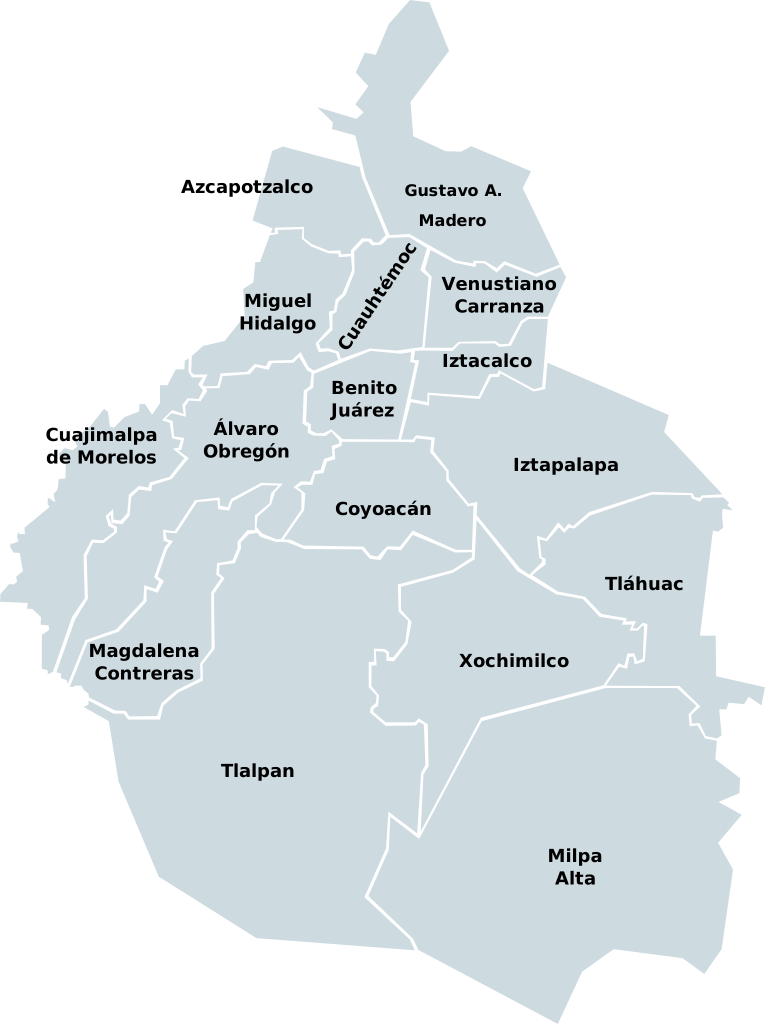
Worst crimes "fell" in Mexico City's Benito Juárez district
Authorities in Mexico City said "high-impact" crimes like murder or shootings had dropped by 20% overall this year in one sector, the mayoral district of Benito Juárez, thanks in part to better governance. The city's Security Cabinet said criminal killings (homicidios dolosos) had dropped by just over 31% this year in comparison with 2024, firearm injuries had halved and all forms of car theft had fallen by over 25%, El Sol de México reported on 21 Decembre. The district, a generally prosperous part of the city, is divided into five policing sectors (del Valle, Nárvarte-Álamos, Portales, Nativitas and Nápoles). Officials said no murders, house thefts or cash-point and taxi muggings had been reported in the preceding four months in the del Valle, Portales and Nápoles sectors. The mayor of Benito Juárez, Luis Mendoza, said this was the fruit of institutional coordination, working with residents and technology.
Saturday, 20 December 2025
Bogotá mayor's popularity slumps over "crime and transportation"
A poll from early December showed widespread dissatisfaction with the Bogotá mayor, Carlos Fernando Galán Pachón, in large part due to an increasing sense of insecurity. Galán had an approval rating of 26% as of 5 December, with 62% of Bogotá residents feeling unsafe, which was unprecedented since 2008 according to the poll Bogotá como vamos. People were also dissatisfied with the Transmilenio bus network, a pioneering system that was nevertheless congested and providing fertile ground for petty crimes like theft and harassment, the public broadcaster reported. A particular source of concern was an apparent increase in brazen street violence, with the city counting 242 deadly brawls this year between 1 January and 30 September, RTVC reported on 18 November.
Colombian president attends coca substitution event, deplores violence
Colombia's President Gustavo Petro Urrego declared on 19 December that 26,000 hectares (260 square kilometres) were "already" in a substitution process to replace coca plants with ordinary crops. Thousands of families had registered with the government's plans to peacefully mobilize communities to replace coca, used in drug production, with honest farming, the public broadcaster RTVC reported him as saying in the district of Roberto Payán. The Trump administration has accused Petro's government of doing little to curb if not conniving with, large-scale drug trafficking toward the United States. Petro said every time a peasant replaced a coca plant with a crop or a tree was a "historic moment" but that substitution must be done alongside local communities, "not against them." He also deplored a recent spike in deadly guerrilla violence. Members of the National Liberation Army (ELN) killed seven soldiers and injured dozens in a surprise attack on a base in Aguachica in northern Colombia on 18 December. On 17 December, other guerrillas termed FARC dissidents subjected the southwestern town of Buenos Aires to shelling for seven hours before being repelled. Petro said the army would immediately buy anti-drone systems as guerrillas were now using drones.
Wednesday, 17 December 2025
Woman in Quito evades death after hitmen see her face
Friday, 31 October 2025
Official says crime "clearly falling" in Mexico City
Mexico City's top police official has said violent crimes had dropped 10%, and the most violent crimes 12%, "this year in comparison with the last one" and that "in general terms," violence had fallen "significantly" in Mexico's capital since 2019. Pablo Vásquez Camacho, the city's Civil Security secretary, told Heraldo Radio on 30 October that "high impact" crimes like murder or kidnapping had "fallen by around 60%" since 2019. This, he said, was thanks to better policing but also the implementation of social and economic programs in deprived parts of the city, El Heraldo de México reported. He repeated his statements that day attending a debate on crime in the city's legislative assembly. He spoke of measures taken under the mayoress Clara Brugada Molina to improve police equipment, pay and work conditions in a systematic bid to stamp out abuse and boost professionalization. Police, he said, had arrested more than 6,700 suspects for high-impact crimes with a 21% increase in prosecutions, and key arrests had allowed the dismantling of "30 criminal cells" over an unspecified period, the website Infobae reported.