The Mexico City subway, serving a city of over nine million residents, reportedly witnessed an average two fights a day between passengers, mostly in the rush hours when trains are filled to the brim. Subway system management found scuffles to be most frequent at 08:30 hours and at two, six and seven in the evening, causing the metro to halt for a total of six days in the past four years, La Jornada reported on 10 February. The daily cited overcrowding and subsequent irritation, and grabbing a seat, as habitual causes of fighting, adding there seemed to be no protocol on handling such incidents. They are often filmed and uploaded online as entertainment.
Showing posts with label MEXICO CITY. Show all posts
Showing posts with label MEXICO CITY. Show all posts
Wednesday, 11 February 2026

Tuesday, 10 February 2026
Rats "freely roam" Mexico City's prestige avenue
Rats recently became an unwelcome sight on Mexico City's Paseo de la Reforma, the emblematic avenue hosting corporate offices and prestige hotels and flats. In parts of the avenue notably outside the Four Seasons Hotel by the Chapultepec park, this was blamed on unspecified locals leaving food on the pavement or stuck on trees, supposedly for the birds and squirrels, El Sol de México reported on 7 February. "That's what the rats eat," a local resident told the daily. Pockets of greenery, scarce and overflowing bins and the abundance of fast-food chains and eateries were other factors making this a desirable area for the critters. Another paper, Milenio, observed on their strolling about "in full daylight."
Wednesday, 4 February 2026
Mexican agents rescue dog from a ravine: he'd been chasing a squirrel
Up to seven Mexican Civil Protection agents rescued a pitbull from a ravine in Coyoacán in southern Mexico City, after it accidentally jumped in while chasing a squirrel, Excelsior reported on 3 February. The daily displayed the rescued dog, his delighted owner Brayan and the agents involved in the 20-minute operation. Brayan commented he had assumed his dog, named Jack, must have died, having fallen 25 metres, but called for help after he peered over the ravine and saw it waiting quietly. "He's usually very quiet but he does chase after squirrels," Brayan said.
Tuesday, 3 February 2026
Small-time drug dealing "flourishing" in Mexico City, extortions were 'stable'
Petty drug dealing increased "notably" in Mexico City, from just under 2,300 registered cases in 2024 to just over 3,400 in 2025, the daily La Jornada reported on 2 February, citing city prosecutors. The Mexico City prosecution service said this was a 48.5% increase and unrelated to mere posession, which remained at a round 2,600 registered incidents in that time. Prosecutors also noted a rise of just over 4% in illegal property occupation or squattting incidents - with around 10 cases a day reported to the police - and signs this was organized in parts of the city. Extortions, one of the country's most resilient, and under-reported, crimes and a daily staple for gangs and even cartels, remained 'stable' through 2024-25, with around 2,400 reported incidents. The daily separately reported on recent attempts at extortion in the elegant Condesa district in central Mexico City. Several businesses told police they had been asked by phone to pay sums ranging from 20,000 to 50,000 pesos (up to 2,400 euros), to avoid getting "machine gunned," La Jornada reported on 31 January. Police increased patrols in response and were observing the targeted shops.
Tuesday, 27 January 2026
Hoodlums shoot wrestler in Mexico "after extortion failed"
A young wrestler or boxer was shot dead in Mexico City on 25 January, in an incident police provisionally pinned on a local extortion racket, the daily La Jornada reported. Christian David López, who fought with MMA (Mixed Martial Arts) México, was shot from a passing motorcycle as he approached a street stand in the Nextenco district of the Azcapotzalco municipality in the capital. Police found that days before, he had refused to pay extortion money to one of the city's gangs, Los Malportados (the 'Badly Behaved'). La Jornada separately reported on 26 January that extortion continued to plague the capital's businesses in spite of the authorities' putative success in reducing violent crime. It stated there were 381 complaints by businesses to the police between June and November 2025, though it is commonly believed most such threats are never reported.
Sunday, 4 January 2026
Mexico City publishes its waste bartering calendar
The Mexican capital published provisional dates in 2026 and venues for its trash-for-goods or swap markets where locals bring in recyclable items to receive food or household products. The city was keener to receive PET plastics, paper and cardboard and glass, all cleaned out, for which it would offer items including fresh produce, the daily Excelsior reported on 2 January. The first event was to be in the Bosque de San Juan park near the aiport on 11 January, and residents were asked to take between one and 10 kilograms of recyclables strictly.
Saturday, 3 January 2026
Mexico City residents "ignoring" trash separation rules..
Trash collectors in parts of Mexico City said on 3 January that city residents were slow or reluctant to comply with new trash separation rules meant to ease recycling and reduce the amount of trash sent into the city's dumps. The new rules came into force in 2026. One truck driver told El Sol de Mexico that judging by the unseparated trash he was collecting in the central Doctores district and additional trash illegally left on pavements, nothing had changed. This was in spite of the city's information campaigns to explain the concept of separation. For now, trash collectors had to work extra as garbage trucks were not being let into processing plants (Estaciones de transferencia) with unseparated trash. Sandra Gazca, a spokeswoman for the Vida Circular (Circular Life) information initiative told the daily however that a 2025 study indicated that 52% of city residents did recycle trash. Legislation to enforce separation began in 2004, with a second city law in 2017 to define the concepts of organic, inorganic and recyclable, the daily reported.
Friday, 2 January 2026
Mexico City gentrification said to have shuttered beloved boutique
One of Mexico City's emblematic shops, established in 1935, was to shut after a sudden rent hike neighbors blamed on "gentrification" and ruthless speculation. The shop, Artículos ingleses (English Articles), was reputed for selling English-style clothing and accessories "not to be found anywhere else in the city," the newspaper La Jornada reported on 31 December. It was located in a busy avenue of the historical district, at the heart of the city's vast tourist economy. Local shopkeeprs told the daily Artículos regularly paid its monthly rent of around 78,000 pesos (well over 3,000 euros) a month, but that a "mafia of brokers" or real estate agents were offering landlords up to four million pesos to change for higher paying tenants that tend to be big brands or retail chains. The capital witnessed protests in July 2025 over the steeply rising cost of home rentals, largely due to tourism and the proliferation of short-term rentals for visitors.
Friday, 26 December 2025
Uber-type services squeezing out Mexico City's taxis..
Mexico City's transportation chief announced on 24 December that the Mexican capital would invest in upgrading its taxi fleet to help it meet the "unfair competition" of ride hailing services like Uber, in time for the the 2026 soccer world cup. The city's Mobility Secretary Héctor García Nieto said at an event to scrap 300 outdated vehicles that the taxi fleet had "more han halved," from 150,000 taxis to 60,000, as drivers no longer found it worth their while to even maintain their cars, La Jornada reported. The city, he said, would offer cash aid to drivers for repairs or to buy electric vehicles, create an application (Taxi CDMX), tighten regulations and security measures for drivers and passengers and replace at least 1,000 existing vehicles. The city's mayoress, Clara Brugada, speaking at the same venue, said "we're going to modernize the technology so city taxis have an application that works and is competitive." She said about 600,000 city residents used taxis every day, with about one million trips made daily.
Tuesday, 23 December 2025
Worst crimes "fell" in Mexico City's Benito Juárez district
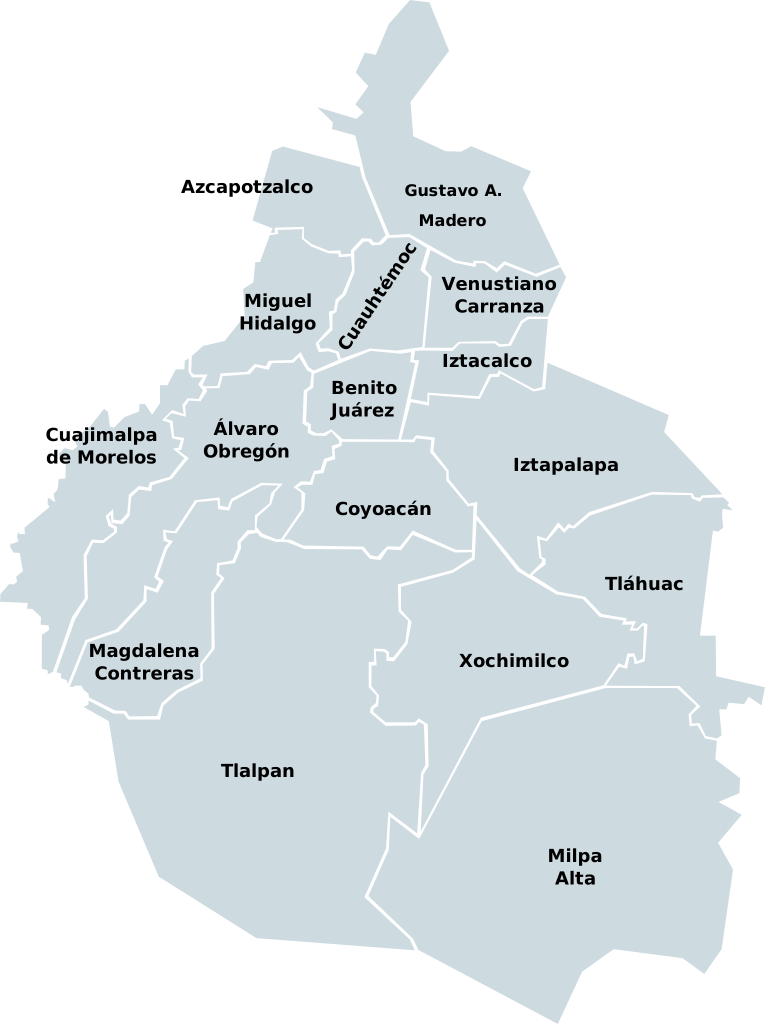
Authorities in Mexico City said "high-impact" crimes like murder or shootings had dropped by 20% overall this year in one sector, the mayoral district of Benito Juárez, thanks in part to better governance. The city's Security Cabinet said criminal killings (homicidios dolosos) had dropped by just over 31% this year in comparison with 2024, firearm injuries had halved and all forms of car theft had fallen by over 25%, El Sol de México reported on 21 Decembre. The district, a generally prosperous part of the city, is divided into five policing sectors (del Valle, Nárvarte-Álamos, Portales, Nativitas and Nápoles). Officials said no murders, house thefts or cash-point and taxi muggings had been reported in the preceding four months in the del Valle, Portales and Nápoles sectors. The mayor of Benito Juárez, Luis Mendoza, said this was the fruit of institutional coordination, working with residents and technology.
Saturday, 20 December 2025
Man jumps to his death in Mexico City after a row at home
A 42-year-old man reportedly threw himself from the fifth floor of a residential building after a row with his spouse on 19 December, in the Obrera district of Mexico City. The man's stepson told police his stepfather jumped through the window shortly after an altercation with his mother, La Jornada reported.
Friday, 19 December 2025
Christmas brings more trash to Mexico City...
The mayoress of Mexico City urged Christmas shoppers to ease up on gift wrapping and curb a seasonal rise of up to 25% in the 8,500 tons of trash the city produces daily. Kickstarting a sustainable Christmas campaign, authorities were setting up over 50 modules in shopping centres around the Mexican capital to provide shoppers with recycled paper to wrap gifts, La Jornada reported on 18 Decembre. "The aim is to be together and have fun, not produce more trash," Clara Brugada said, speaking inside the Reforma 222 shopping and residential complex. The city's chief environmental officer, Julia Álvarez Icasa, said Christmas was an "environmental challenge" for a city with over nine million residents but also an opportunity to offer people "responsible alternatives." Brugada recalled the city's plans to enforce trash separation at home in 2026.
Wednesday, 10 December 2025
Bad Bunny concerts to "shower cash" on Mexico City
Mexico City's Trade Chamber said that eight concerts by the Puerto Rican singer Bad Bunny would generate over U.S. $170 million's worth of tourist business for Mexico City over December. The concerts, scheduled for between 10 and 21 December, were largely sold out beforehand and expected to bring in more than half a million fans into the Mexican capital, fueling consumption across the hospitality sector. Hotels near the concert venue, the GNP Seguros stadium, were expected to be filled at a 80-90% rate, Spain's El País reported. One of the tourists was Bad Bunny himself, spotted attending a Mexican "free wrestling" match on 9 December.
Wednesday, 3 December 2025
Mexico City wants to "curb HIV" by 2030
Mexico City's mayoress said on 1 December that the city was stepping up its fight against AIDS, especially through prevention, by opening the city's largest clinic yet to treat sexually transmitted diseases (STDs). Clara Brugada Molina was speaking on World Aids Day. She said a third branch of the Clinica especializada Condesa would be "completed" through "this year and the next" in the Gustavo A. Madero sector of the city, Once Noticias reported. The city would also open a permanent quick testing facility in the Glorieta de Insurgentes, one of the Mexican capital's busy intersections, and keep urging people to get tested for the HIV virus. The city government says more than 17,500 people had received the PrEP treatment in 2025 "to help significantly reduce HIV infection," and this was becoming more prevalent. Around 360,000 people are thought be HIV-positive across Mexico, with 21% of those in the capital and 30% of all the infected not knowing their HIV status, Once Noticias stated.
Friday, 31 October 2025
Official says crime "clearly falling" in Mexico City
Mexico City's top police official has said violent crimes had dropped 10%, and the most violent crimes 12%, "this year in comparison with the last one" and that "in general terms," violence had fallen "significantly" in Mexico's capital since 2019. Pablo Vásquez Camacho, the city's Civil Security secretary, told Heraldo Radio on 30 October that "high impact" crimes like murder or kidnapping had "fallen by around 60%" since 2019. This, he said, was thanks to better policing but also the implementation of social and economic programs in deprived parts of the city, El Heraldo de México reported. He repeated his statements that day attending a debate on crime in the city's legislative assembly. He spoke of measures taken under the mayoress Clara Brugada Molina to improve police equipment, pay and work conditions in a systematic bid to stamp out abuse and boost professionalization. Police, he said, had arrested more than 6,700 suspects for high-impact crimes with a 21% increase in prosecutions, and key arrests had allowed the dismantling of "30 criminal cells" over an unspecified period, the website Infobae reported.
Friday, 17 October 2025
Mexico City swapping recyclable trash for produce and basic items
The government of Mexico City was to hold one of its 'bartering' or swap markets on 19 October, wherein residents trade their recyclable trash for foodstuffs including fresh vegetables. The fairs' dates and locations are changeable though tending to take place every week or fortnight since 2025. This one was scheduled for the morning hours, inside the Chapultepec park. The markets are part of the city's bid to boost trash separation and recycling habits in the population, El Sol de México reported on 16 October. Its government wants to halve the amount of trash sent to landfills by 2030, within its Basura cero or Zero Trash agenda.
Tuesday, 14 October 2025
Mexico City to enforce trash separation in homes
Mexico City will gradually enforce trash separation at source from January 2026, aiming to halve the refuse sent into landfills by 2030, and recover and reuse as much as possible. The city's mayoress, Clara Brugada, said all schools, offices and households would have to divide their trash into organic, recyclables and non-recyclables from 1 January, and the city had two months to prepare people for what she said was "no minor task," the website Animal político reported on 8 October. The city, with a population exceeding 9.2 million people, reportedly generates 8,600 tons of trash daily. This was less than the 12,900 tons reported as produced daily in 2016. Brugada said the city would boost its collecting and recycling budget, with the goal of composting organic trash and turning non-organic materials into final products ranging from fuel to tarmac, acoustic padding and the like. The city has vowed to cut its carbon emissions 35% over an unspecified time. The environmental organization Greenpeace warned on 7 October that government-backed initiatives favoring reuse or recycling of plastic - and often praised as part of a sustainable or circular economy - were often ploys to prevent moves to curb relentless plastic production in line with big-business interests. As was pointed out in 2016, the Mexican capital's problem was not recycling, but the sheer amount of trash the city 'spewed out' every day.
Saturday, 11 May 2019
Mexico City, Oaxaca vote to ban single-use plastics
The legislature of Mexico City voted on 10 May to ban the "use and distribution" of disposable plastics in the capital from 2020. Almost all members voted to gradually enforce the ban, intended to reduce the mountain of trash the city generates daily. Similar measures being enacted across Mexico typically affect items like bags, straws, styrofoam trays or coffee lids. Mexico City would allow shops to hand out bags if these could degrade entirely within 90 days of disposal, though it was not clear if such bags presently exist in Mexico. The measure will include coffee capsules from 2021, Milenio reported. The state of Puebla also voted on 24 April to ban disposable plastics from 2020, first enforcing the measure in the state capital Puebla, with a population of 1.6 million. Both states would complement the bans with informative campaigns. The southern state of Oaxaca and eastern state of Tabasco have also approved restrictions. Oaxaca voted a gradual ban in early April, with enforcement beginning in government offices, which could no longer buy, use or distribute throwaway plastics, the website Prensa Latina reported on 15 April. Greenpeace in Mexico estimated in early 2019 that the country produced some 10,000 tonnes of plastic trash daily.
Friday, 25 December 2015
Christmas brings trash to Mexico City
Mexico City authorities estimated the city would generate about 4,200 tons of trash on Christmas Eve in addition to roughly 12,800 tons the megalopolis produces daily, Excelsior reported on 25 December. Mexico City has in past years had problems disposing of its daily household waste, which includes significant amounts of plastic, very little of which is separated at source. An environmental officer from the city's Venustiano Carranza sector, Elena Cortés, observed that much of this extra waste would consist of electronic components and batteries, which she stated had to be disposed of correctly and taken to recycling centers. According to one study cited in Excelsior, every resident of Mexico City used on average 12.6 batteries a year. The city and its environs are estimated to have about 20 million inhabitants. Ahead of Christmas, the city government and its Environment office launched a campaign urging people to reduce their trash, especially by avoiding excess packaging and ribbons for presents, the Diario de México reported on 20 December, citing Notimex. The campaign pointed out that people generated 30 per cent more trash over Christmas and 35 per cent of that consisted of packaging. In normal conditions, Mexico City reportedly produces 12,816,000 tons of trash daily, according to the 2013 Solid Waste Inventory. The city's website examines in parts the reasons for "so much waste" being produced in the Mexican capital.
Thursday, 19 February 2015
Bike rentals expand in Mexico City, now fourth network worldwide
The mayor of Mexico City praised the city's bicycle rental system on its fifth anniversary on 16 February, and boasted that the network was now the fourth biggest in the world, after Hangzhou, London and Paris. The city has taken a range of measures in past years to cut traffic and pollution, including boosting public transport and promoting residential property in the city center, which would reduce commuting. Mayor Miguel Ángel Mancera was speaking at the ECOBICI rental system's expansion into a third, southern sector of the city, Benito Juárez. He said the city now had 444 bike stations and 6,500 bicycles operating in 42 neighbourhoods or colonias. "We are going to keep reinforcing and pushing for bicycle use in Mexico City," Milenio cited him as saying. The ECOBICI rental system estimated that use of its bicycles in 2010, 2011 and 2012 had in total saved 232 tonnes of CO2 emissions, equivalent to planting 697 trees. Yet cycling remains hazardous in this car-dominated megalopolis, and biking associations earlier asked the city's Environment Secretary Tanya Müller to act to ensure safer cycling, including by forcing the city's sometimes ramshackle, and often intimidating, minibuses to drive sensibly. The newspaper Excelsior separately reported the first act of vandalism against a bicycle station inaugurated in Benito Juárez, suspected to have been the work of local residents who had lost their habitual "parking space" to bicycles.
Subscribe to:
Posts (Atom)