A Venezuelan policeman arrested in 2024 on "treason" charges was reported to have died in jail on 10 January, state prosecutors and local rights groups stated. Stated prosecutors declared that Edison Torres Fernández, a 52-year-old officer convicted of "treason against the fatherland," died from a brain stroke followed by a heart attack in spite of "timely" medical attention, Univisión and the Agence France-Presse reported on 13 January. The death in custody came after a pledge by the interim government to release hundreds of detainees. This was being done but at a laborious pace, further fueling suspicions the regime was fiddling the numbers on how many it had released. One activist separately told CNN on 10 January that those released were in any case, effectively on probation rather than unconditionally free.
Tuesday, 13 January 2026

Murders said to have dropped by a third in Mexico's Tijuana
Authorities in the district of Tijuana in northern Mexico said criminal killings (homicidios dolosos) dropped 32% in 2025 compared to 2024, with better policing and coordination between local and state authorities. "Preliminary figures" given by the state prosecution service of the state of Baja California showed there were just over 1,200 criminal killings in 2025 in Tijuana, a district of around two million residents, compared to just over 1,800 in 2024, the newspaper Excelsior reported on 13 January. It observed that tighter coordination between the various levels of government - local, state and national - was a crucial part of the security strategy of the government of President Gloria Sheinbaum Pardo. A chart showed April to have been the deadliest month in Tijuana in 2024, with 173 reported killings that fell to 102 for the same month in 2025.
Honduran army says stands by election results
The head of the Honduran armed forces confirmed on 12 January that the army had already recognized the results of presidential elections on 30 November and would help assure a transfer of presidential powers this month, regardless of any bid for another recount of votes. The ruling party of President Xiomara Castro whose candidate was roundly defeated, earlier appeared to have engineered a recount. But the head of the armed forces joint chiefs of staff, Héctor Valerio, said the army obeyed the constitution and "we are still backing" the electoral authority's December verdict, which declared the conservative Nasry Asfura president-elect, Spain's EFE news agency reported. The president, he stated, had "at no time given me instructions" to hand over ballots for a recount, referring to the army's role in guarding the premises of the electoral authoritiy. Asfura is to begin a four-year term on 27 January, and travelled to the United States on 13 January to meet with U.S. officials, EFE reported.
Monday, 12 January 2026
Nicaragua releases detainees..
Nicaragua's socialist regime announced on 10 January that it was freeing "dozens of persons" held in the country's prisons, as a conciliatory gesture and to mark the 19th anniversary of the presidency of Daniel Ortega. This seemed to include "more than 20" of some 60 or more jailed opponents," Spain's ABC newspaper reported, citing agencies and Nicaraguan exiles.The U.S. State Department's Bureau of Western Hemispheric Affairs reacted online, saying Ortega's presidential term, which began in 2007, should have ended some years back. The release was attributed to pressures by the Trump administration and echoed similar developments in Venezuela. There, the regime freed around 24 detainees on 12 January, in addition to 17 it released in recent days also under U.S. pressure, according to Foro Penal, a rights group. The interior ministry claimed in contrast that it had freed over 100 prisoners in recent days, and 187 in December, CNN reported.
Honduran president orders a recount of all presidential votes
Xiomara Castro, the socialist president of Honduras set to leave office on 27 January, ordered a recount on 9 January of "every single vote" cast in the presidential elections of 30 November, insisting yet again that the results were not right, Spain's EFE news agency reported. The poll gave the conservative candidate a narrow victory that was confirmed by the country's electoral body, though the Liberal contender and Castro's own administration rejected the final count, suspecting it might have been tweaked to satisfy the Trump administration. By loudly backing the conservative candidate, Castro insisted, the United States had thus meddled in the elections, Mexico's La Jornada reported on 11 January. The recount was approved by parliament on 10 January at a session that excluded more than 70 opposition members, and there were speculations the army might block it , EFE reported.
Destruction of the Amazon slowed, somewhat, under Lula da Silva
Satellite pictures showed an 8.7% reduction in Amazonian deforestation in Brazil in 2025 compared to 2024, with a total of just over 3,800 square kilometres cut down or burned that year, Brazil's INPE or National Institute of Space Research revealed in January. There was a similar, nine per cent year-on-year drop in the destruction rate of the Cerrado, a grasslands region listed as a unique ecosystem, Mexico's La Jornada reported on 9 January, citing INPE. This was the first time deforestation dropped simultaneously in both environmental zones even if the area destroyed "remained twice the size of Sao Paulo," the paper observed. It attributed the decline clearly to policies of the administration led by the socialist President Luiz Inacio Lula da Silva, as rainforest destruction peaked at over 10,000 square kilometres in 2022, the last year of the presidency of the rightist Jair Bolsonaro. The Brazilian state most successful in this regard in 2025 was Pará in northern Brazil, which cut deforestation by 36%. The government wants to end Amazonian deforestation entirely by 2030.
Friday, 9 January 2026
Venezuelan regime says it is freeing opponents
Venezuela's interim presidency announced on 8 January that it would release an "important number" of political detainees in a gesture of appeasement it insisted was unrelated to any U.S. pressure. The announcement was made by the Speaker of parliament Jorge Rodríguez (the interim president's brother), who also thanked three intermediaries - Brazil's president, a former Spanish prime minister and the state of Qatar - presumably for their role in the release of foreign detainees. Numbers however were scarce nor was there any loosening of the regime's police-state tactics on the streets. The rights group Foro Penal had counted 806 such prisoners as of 5 January, CNN reported on 8 January, while the few released early on appeared to be foreigners and some politicians. U.S. President Donald J. Trump wrote online on 9 January that the regime was freeing "large numbers of political prisoners," with a collaborative attitude that had avoided further U.S. strikes on the country.
Rights body in Mexico appalled by levels of violence on minors
A Mexican children's rights association revealed in January that around 1,991 children and teenagers were reported as murdered in Mexico through 2025, a figure it described as critical in spite of an 11% year-on-year drop in such crimes. REDIM or the Network for Childhood Rights in Mexico separately observed a 30% rise in kidnappings of minors to reach over 10,680 cases in that period, the daily La Jornada reported on 6 January. Over 2,850 of those minors were still missing, the report stated.
Mexican authorities see steady drop in daily murders, nationwide
Mexico's President Claudia Sheinbaum Pardo declared in Mexico City on 8 January that criminal killings or murders (homicidios dolosos) dropped 40% in daily average terms between September 2024 and December 2025. Sheinbaum told her morning press conference that this was due to better security policies and coordination between national and local authorities through the SNSP or National System of Public Security, Once Noticias reported. "This means 34 homicides less a day, and that is the lowest figure since 2016," she said, adding, "it is the result of a security strategy that is giving results and very tight coordination in all areas of security, justice and with state governors." The head of the SNSP, Marcela Figueroa Franco, also spoke, saying Mexico saw an average of 86.9 homicides a day in September 2024 drop to 52.4 in December 2025. That month, she said, the country had a murder rate of 17.5/100,000 residents, compared to "a peak" of 29.1/100,000 in 2018. The announcements broadly coincided with threats by the U.S. President Donald J. Trump to start striking the drug cartels that "are running Mexico."
Tuesday, 6 January 2026
Police arrest Tijuana couple for killing a puppy
Police arrested a couple in Tijuana in northern Mexico for beating a pitbull puppy to death on 27 December. They were seen, and filmed, beating the creature before putting its remains in a suitcase, the daily Heraldo de México reported on 5 January. The pictures were posted on social media, prompting an animal rights groups, Patitas firmes, to call the police. The couple may be jailed for up to five years and fined if convicted of relevant charges of cruelty to animals. Neighbors were said to be so incensed with the couple's conduct they had gathered for a possible lynching, El Sol de Tijuana reported.
Venezuelan hardliners seek tighter control at home amid U.S. threats..
The Miami Herald reported on 5 January on the Venezuelan interior minister's defiant tone toward the United States following the raid that captured the country's former leader Nicolás Maduro. Diosdado Cabello Rondón, himself a wanted figure in the United States for suspected involvement in large-scale drug trafficking, was cited as urging regime elements to patrol the streets and vowing revenge on those who aided the U.S. raid on 3 January. These faced possible arrest, CNN reported. "I'm in the street... let's go onto the streets, whatever we can (do)," Miami's El Nuevo Herald cited Cabello as saying in unspecified voice messages. He said of U.S. forces, "these rats attacked and will regret it the rest of their lives." It wasn't clear in that case if he would obstruct the acting president's bid to work with the Trump administration, which had threatened further punitive raids. Media reported on 6 January that the administration expected the interim presidency of Delcy Rodriguez to expel agents of Cuba and the Islamic Republic of Iran, stop selling oil to powers hostile to the United States and boost efforts to fight drug trafficking. Her government's relationship with U.S. officials picked to help run the country for at least a month, remained unclear.
Venezuela swears in acting president in Maduro's absence
Venezuela's former vice-president Delcy Rodríguez was formally sworn in as acting president in Caracas on 5 January even as she insisted the country's former ruler, Nicolás Maduro, remained the proper president. Maduro and his wife, who were captured by U.S. forces early on 3 January, were meanwhile formally charged with drug-trafficking offences in a New York court on 5 January. They rejected the charges and declared themselves to be the president and first lady of Venezuela, and war captives. Maduro is to reappear in court on 17 March, the website Infobae and agencies reported. Venezuela was for now in a state of External Commotion giving its regime emergency powers and postponing any bid to initiate a transition to democratic and constitutional rule. The United States previously threatened to repeat air strikes should the interim administration refuse to collaborate with U.S. forces, though President Donald J. Trump had insisted it was, without giving details. Late on 5 January, Venezuelan authorities claimed they had fought off hostile or suspect drones flying around the presidential palace. This appeared to be unrelated to Trump's threats.
Sunday, 4 January 2026
Mexico City publishes its waste bartering calendar
The Mexican capital published provisional dates in 2026 and venues for its trash-for-goods or swap markets where locals bring in recyclable items to receive food or household products. The city was keener to receive PET plastics, paper and cardboard and glass, all cleaned out, for which it would offer items including fresh produce, the daily Excelsior reported on 2 January. The first event was to be in the Bosque de San Juan park near the aiport on 11 January, and residents were asked to take between one and 10 kilograms of recyclables strictly.
Venezuelan vice-president becomes acting president.. amid uncertainties
Venezuela's Supreme Court of Justice appointed the country's vice-president, Delcy Rodríguez, as acting president on 3 January even as the former president, Nicolás Maduro, and his wife Cilia Flores were to face drug trafficking and organized crime charges in a New York court. The two were nabbed by U.S. forces in a ligthning, pre-dawn operation in Caracas that day. U.S. President Donald J. Trump later announced his administration would run Venezuela through an unspecified transition period, apparently dismissing any idea of handing the country over to opposition politicians. While Delcy Rodríguez was reportedly talking to U.S. officials in private, in public she immediately formed a national Defence Council and demanded her predecessor's immediate release as, she insisted, he remained the "legitimate president." Trump told a press conference in Florida that day that it would be "very tough" for Venezuela's leading opponent and Nobel Peace laureate María Corina Machado to lead the country's transition back to democracy, as she lacked the "support... or respect" needed to do so. Machado did receive an early expression of support for her role in the form of a phone call from the French president. Separately in Colombia, a former conservative vice-president, Francisco Santos, suggested, speaking to the private Colombian broadcaster NTN24, that Rodriguez appeared to be a more docile option for the United States at present, adding "I am absolutely certain Delcy handed Maduro" over to the Americans. "It's going to be harder now for María Corina," he added, commenting on the United States' own objectives and business interests in Venezuela.
Saturday, 3 January 2026
Mexico City residents "ignoring" trash separation rules..
Trash collectors in parts of Mexico City said on 3 January that city residents were slow or reluctant to comply with new trash separation rules meant to ease recycling and reduce the amount of trash sent into the city's dumps. The new rules came into force in 2026. One truck driver told El Sol de Mexico that judging by the unseparated trash he was collecting in the central Doctores district and additional trash illegally left on pavements, nothing had changed. This was in spite of the city's information campaigns to explain the concept of separation. For now, trash collectors had to work extra as garbage trucks were not being let into processing plants (Estaciones de transferencia) with unseparated trash. Sandra Gazca, a spokeswoman for the Vida Circular (Circular Life) information initiative told the daily however that a 2025 study indicated that 52% of city residents did recycle trash. Legislation to enforce separation began in 2004, with a second city law in 2017 to define the concepts of organic, inorganic and recyclable, the daily reported.
Trump reports Nicolás Maduro's arrest..
U.S. President Donald J. Trump wrote online on 3 January that U.S. forces working with U.S. Law Enforcement had captured Venezuela's President Nicolás Maduro and his wife and flown them out of the country, following air strikes carried out before dawn that day on sites in Venezuela. The announcement became an immediate headline on news websites.
United States strikes targets in Venezuela
Friday, 2 January 2026
Colombian government says it curbed deforestation in 2025
Colombia's government claimed the rate of destruction of its Amazonian rainforest fell 25% in the first nine months of 2025 compared to that period in 2024. The state body monitoring deforestation, IDEAM, noted the removal of some 36,300 hectares (or 363 square kilometres) of forest canopy between January and the end of September, compared to 48,500 hectares the previous year, Bogotá's Radio Santa Fe reported on 31 December. Almost all deforestation in Colombia happens in the departments of Meta, Caquetá, Guaviare and Putumayo, and mainly caused by the expansion of farming, cattle farming or coca cultivation into the rainforest. The report attributed the partial success to a range of initiatives including reforestation programs and collaboration with local communities.
Mexico City gentrification said to have shuttered beloved boutique
One of Mexico City's emblematic shops, established in 1935, was to shut after a sudden rent hike neighbors blamed on "gentrification" and ruthless speculation. The shop, Artículos ingleses (English Articles), was reputed for selling English-style clothing and accessories "not to be found anywhere else in the city," the newspaper La Jornada reported on 31 December. It was located in a busy avenue of the historical district, at the heart of the city's vast tourist economy. Local shopkeeprs told the daily Artículos regularly paid its monthly rent of around 78,000 pesos (well over 3,000 euros) a month, but that a "mafia of brokers" or real estate agents were offering landlords up to four million pesos to change for higher paying tenants that tend to be big brands or retail chains. The capital witnessed protests in July 2025 over the steeply rising cost of home rentals, largely due to tourism and the proliferation of short-term rentals for visitors.
Friday, 26 December 2025
Christmas killings dropped across Colombia
A "preliminary count" of criminal acts committed across Colombia on Christmas Eve found a 20% drop in killings compared to 2024. Police counted 48 homicides across the country that evening, four of which were femicides (compared to eight in 2024) and eight happening in Bogotá, and observed a 30% drop in domestic violence, Bogotá's City TV reported, citing the national police chief, Hebert Benavides. More than 180,000 policemen and women had been deployed nationwide to boost security, which allowed just over 16,200 interventions to break up drunken incidents, fights or disputes in residential buildings. A little over 5,100 brawls were reported across the land that day. Broadly corroborating the figures, the defence ministry stated that homicides had dropped eight percent year-on-year in December, "or 78 lives saved," Radio Santa Fe reported.
Uber-type services squeezing out Mexico City's taxis..
Mexico City's transportation chief announced on 24 December that the Mexican capital would invest in upgrading its taxi fleet to help it meet the "unfair competition" of ride hailing services like Uber, in time for the the 2026 soccer world cup. The city's Mobility Secretary Héctor García Nieto said at an event to scrap 300 outdated vehicles that the taxi fleet had "more han halved," from 150,000 taxis to 60,000, as drivers no longer found it worth their while to even maintain their cars, La Jornada reported. The city, he said, would offer cash aid to drivers for repairs or to buy electric vehicles, create an application (Taxi CDMX), tighten regulations and security measures for drivers and passengers and replace at least 1,000 existing vehicles. The city's mayoress, Clara Brugada, speaking at the same venue, said "we're going to modernize the technology so city taxis have an application that works and is competitive." She said about 600,000 city residents used taxis every day, with about one million trips made daily.
Thursday, 25 December 2025
Conservative declared president-elect in Honduras
The candidate of the conservative National Party of Honduras, Nasry Asfura Zablah, was on 24 December declared winner of the presidential elections held on 30 November, after a prolonged vote count. His rival, the liberal Salvador Nasralla, said he would challenge Asfura's tiny victory margin in the courts, without calling for protests, while the outgoing administration of President Xiomara Castro also voiced doubts about the results. Asfura, formerly mayor of Tegucicalpa from 2014 to 2022, was immediately congratulated by the Trump administration, and soon after by several international actors including eight, conservative-run Latin American states, the United Kingdom, the European Union and the Organization of American States. He was expected, in line with his stated positions, to focus on the economy, government transparency and tackling corruption, CNN reported. Asfura is to take office on 27 January, 2026.
Tuesday, 23 December 2025
Worst crimes "fell" in Mexico City's Benito Juárez district
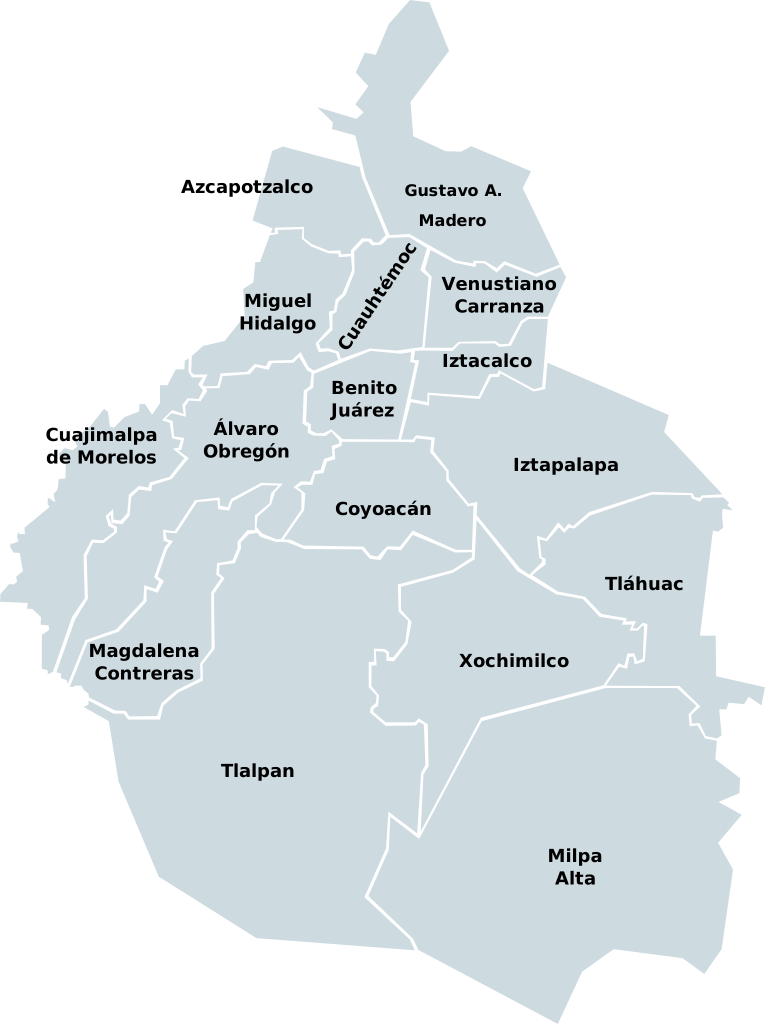
Authorities in Mexico City said "high-impact" crimes like murder or shootings had dropped by 20% overall this year in one sector, the mayoral district of Benito Juárez, thanks in part to better governance. The city's Security Cabinet said criminal killings (homicidios dolosos) had dropped by just over 31% this year in comparison with 2024, firearm injuries had halved and all forms of car theft had fallen by over 25%, El Sol de México reported on 21 Decembre. The district, a generally prosperous part of the city, is divided into five policing sectors (del Valle, Nárvarte-Álamos, Portales, Nativitas and Nápoles). Officials said no murders, house thefts or cash-point and taxi muggings had been reported in the preceding four months in the del Valle, Portales and Nápoles sectors. The mayor of Benito Juárez, Luis Mendoza, said this was the fruit of institutional coordination, working with residents and technology.
Colombian government extends native rule over ancestral lands
The Colombian government decreed the formation of eight self-governing territories in the country's Amazonian regions, to be run in part by native authorities in line with the country's 1991 constitution. These would be the first Indigenous Territorial Entities and enact constitutional provisions on native communities exercising partial control of their ancestral territories, the Environment Minister Irene Vélez Torres said in Bogotá on 18 December. There was an historical debt to those communities whose traditional authorities constituted legitimate governments in their own rights, she said. The Colombian state would thus deal with them on a "government to government" basis, and collaborate in safeguarding cultural rights and the rainforest, the public broadcaster RTVC reported. Their powers would encompass administration, planning but also direct receipt and management of funds including foreign aid funds. The government has stressed this was no concession but the enforcement of existing constitutional rights. The government was separately taking steps to legally restore the rights of particular native and Afrocaribbean communities to live in and utilize 294,000 hectares (2,940 square kilometers) of lands from which they had been expelled in past decades, RTVC reported on 22 December.
Saturday, 20 December 2025
Man jumps to his death in Mexico City after a row at home
A 42-year-old man reportedly threw himself from the fifth floor of a residential building after a row with his spouse on 19 December, in the Obrera district of Mexico City. The man's stepson told police his stepfather jumped through the window shortly after an altercation with his mother, La Jornada reported.
Bogotá mayor's popularity slumps over "crime and transportation"
A poll from early December showed widespread dissatisfaction with the Bogotá mayor, Carlos Fernando Galán Pachón, in large part due to an increasing sense of insecurity. Galán had an approval rating of 26% as of 5 December, with 62% of Bogotá residents feeling unsafe, which was unprecedented since 2008 according to the poll Bogotá como vamos. People were also dissatisfied with the Transmilenio bus network, a pioneering system that was nevertheless congested and providing fertile ground for petty crimes like theft and harassment, the public broadcaster reported. A particular source of concern was an apparent increase in brazen street violence, with the city counting 242 deadly brawls this year between 1 January and 30 September, RTVC reported on 18 November.
Colombian president attends coca substitution event, deplores violence
Colombia's President Gustavo Petro Urrego declared on 19 December that 26,000 hectares (260 square kilometres) were "already" in a substitution process to replace coca plants with ordinary crops. Thousands of families had registered with the government's plans to peacefully mobilize communities to replace coca, used in drug production, with honest farming, the public broadcaster RTVC reported him as saying in the district of Roberto Payán. The Trump administration has accused Petro's government of doing little to curb if not conniving with, large-scale drug trafficking toward the United States. Petro said every time a peasant replaced a coca plant with a crop or a tree was a "historic moment" but that substitution must be done alongside local communities, "not against them." He also deplored a recent spike in deadly guerrilla violence. Members of the National Liberation Army (ELN) killed seven soldiers and injured dozens in a surprise attack on a base in Aguachica in northern Colombia on 18 December. On 17 December, other guerrillas termed FARC dissidents subjected the southwestern town of Buenos Aires to shelling for seven hours before being repelled. Petro said the army would immediately buy anti-drone systems as guerrillas were now using drones.
Friday, 19 December 2025
Christmas brings more trash to Mexico City...
The mayoress of Mexico City urged Christmas shoppers to ease up on gift wrapping and curb a seasonal rise of up to 25% in the 8,500 tons of trash the city produces daily. Kickstarting a sustainable Christmas campaign, authorities were setting up over 50 modules in shopping centres around the Mexican capital to provide shoppers with recycled paper to wrap gifts, La Jornada reported on 18 Decembre. "The aim is to be together and have fun, not produce more trash," Clara Brugada said, speaking inside the Reforma 222 shopping and residential complex. The city's chief environmental officer, Julia Álvarez Icasa, said Christmas was an "environmental challenge" for a city with over nine million residents but also an opportunity to offer people "responsible alternatives." Brugada recalled the city's plans to enforce trash separation at home in 2026.
Wednesday, 17 December 2025
Woman in Quito evades death after hitmen see her face
Bogotá producing record amounts of trash
The Colombian capital may come to generate well over two million tons of solid trash in 2025, which authorities said was a record. The city was now producing over 6,300 tons of trash every day, exceeding the more than 6,100 tons a day produced in 2024 and around 6,000 tons daily for 2023, El Espectador reported on 14 December, citing the firm running the city's main dump. The city had already generated over 1.92 million tons of trash this year and was expected to beat the 2024 figure of over 2.2 million tons. The figures showed an urgent need for trash management and especially separation, according to the manager of the Doña Juana landfill, Andrea Pérez Cadavid. Observers warned the capital, with a population over over 8.4 million, could face a trash crisis after 11 February 2026, as trash disposal firms' existing contracts end and a "competitive" phase begins in which concessinoary firms could select service sectors and opt for more lucrative parts of the city.
Trump administration to blockade Venezuelan oil
U.S. President Donald J. Trump ordered a "total blockade" of Venezuelan oil exports using "sanctioned oil tankers" on 16 December, further tightening the screws on the already sanctioned regime of the socialist President Nicolás Maduro. Trump accused "the illegitimate Maduro regime" of stealing "oil, land and other assets" belonging to the United States to finance a range of criminal activities, and declared the regime "a foreign terrorist organization." The United States had in recent months undertaken selective strikes on boats identified as drug-trafficking vessels, but the latest decision, which Venezuela denounced as a "grotesque threat," was being seen as intended to topple Maduro. Practically no Western state recognized his controversial reelection in 2024, and the European Union recently prolonged its own sanctions on the regime over its rights violations and suspected hijacking of the 2024 presidential elections.
Chile votes in "arch-conservative" as next president
The conservative José Antonio Kast Rist was elected on 14 December as Chile's next president, winning 58% of votes cast that day against 42% cast for his rival, the "communist moderate" Jeannette Jara. Some media and observers abroad were describing Kast as a right-wing extremist or "arch-conservative," highlighting his putative admiration for the country's military regime of the 1970s. Conservatives and liberals however cheered the result as another sign of the region ditching socialism. Colombia's socialist president, Gustavo Petro, warned, writing on X (Twitter), that "fascism is advancing. I shall never shake the hand of a Nazi or son of a Nazi," prompting a protest note from Chile's outgoing government. Kast, a practising Catholic, is of German ancestry, and vowed after his election to govern for all Chileans. His first trip abroad as president-elect was to Argentina, where he was "effusively" received by his right-wing peer President Javier Milei. "What a triumph... it was glorious," Milei said as he embraced Kast in his office. Kast is to formally take power on 11 March, 2026.
Thursday, 11 December 2025
Bolivia restores ties with Israel, last president held over monies
Bolivia's new centre-right government restored formal diplomatic ties with Israel on 9 December after a two-year break under the country's last, leftist government. In late October 2023, with the socialist Luis Arce as president, Bolivia became one of the first Latin American states to sever ties with Israel in protest at its punitive actions in Gaza, before joining a multilateral lawsuit against Israel in 2024, the Agence France-Presse reported. The renewal of ties was signed in Washington D.C. at a meeting between Bolivia's foreign minister and the Israeli ambassador to the United States. Separately, the former president Arce was detained on 10 December for questioning in relation with the suspected embezzlement of public funds in his presidency. Arce has in the past denied involvement in any acts of corruption and exercised his right to be silent, though he remained in police custody after his interrogation, the website Infobae reported.
Wednesday, 10 December 2025
Bad Bunny concerts to "shower cash" on Mexico City
Mexico City's Trade Chamber said that eight concerts by the Puerto Rican singer Bad Bunny would generate over U.S. $170 million's worth of tourist business for Mexico City over December. The concerts, scheduled for between 10 and 21 December, were largely sold out beforehand and expected to bring in more than half a million fans into the Mexican capital, fueling consumption across the hospitality sector. Hotels near the concert venue, the GNP Seguros stadium, were expected to be filled at a 80-90% rate, Spain's El País reported. One of the tourists was Bad Bunny himself, spotted attending a Mexican "free wrestling" match on 9 December.
Mexico to ban 'vaping'
Mexico's parliament approved in principle on 9 December a reform of the country's General Health Law to ban "the production, distribution and sale" of all forms of vaping and electronic smoking devices. The reform contemplates fines of up to 226,000 pesos (over U.S. $10,000) or jail terms of between one and eight years for infractors, Spain's El País newspaper reported. The administration of President Gloria Sheinbaum is already enforcing strict anti-smoking laws but critics in parliament protested that the new law would unfairly criminalize users who are often youngsters. In response, the head of parliament's health committee, from the governing MORENA party, vowed that new norms would be tweaked to ensure ordinary vapers would not face punitive measures. The legislation, he said, was to protect youth from a harmful practice that had been insidiously promoted as harmless. A member of the opposition Citizen's Movement party, Irais Reyes, said this was "the most prohibitionist, authoritarian and absurd reform this country has seen in decades. In which world is vaping more dangerous than hitting, humiliating and carrying firearms?"
Thursday, 4 December 2025
Trump pardons jailed former Honduran leader
U.S. President Donald J. Trump issued a "full and complete pardon" on 1 December for the jailed former Honduran president, Juan Orlando Hernández, who was serving time in the United States following a drug trafficking conviction. Hernández, a "tough on crime" conservative who was president from 2014 to 2022, was extradited that year by the Democratic Biden administration and convicted in 2024 of conniving in large-scale drug trafficking toward the United States. Trump wrote online on 28 November that he had been treated "very harshly and unfairly." Observers including media outlets and some U.S. lawmakers immediately derided the pardon as contradicting Trump's current war on drugs and specifically, pressures being exerted on Venezuela's socialist president, Nicolás Maduro, precisely for aiding drug trafficking into the United States. Colombia's President Gustavo Petro wrote on X (Twitter) that it was "demoralizing" to all those risking their lives to fight trafficking to see a "drug trafficker pardoned." Another critic was the Liberal Party presidential candidate in Honduras, Salvador Nasralla, who was awaiting a recount of votes cast in the general election of 30 November. He said Hernández could expect to be tried in Honduras should he return. Hernández and his wife thanked Trump for the pardon but were not planning an immediate return home due to security concerns, according to the Agence France-Presse.
Wednesday, 3 December 2025
Mexico City wants to "curb HIV" by 2030
Mexico City's mayoress said on 1 December that the city was stepping up its fight against AIDS, especially through prevention, by opening the city's largest clinic yet to treat sexually transmitted diseases (STDs). Clara Brugada Molina was speaking on World Aids Day. She said a third branch of the Clinica especializada Condesa would be "completed" through "this year and the next" in the Gustavo A. Madero sector of the city, Once Noticias reported. The city would also open a permanent quick testing facility in the Glorieta de Insurgentes, one of the Mexican capital's busy intersections, and keep urging people to get tested for the HIV virus. The city government says more than 17,500 people had received the PrEP treatment in 2025 "to help significantly reduce HIV infection," and this was becoming more prevalent. Around 360,000 people are thought be HIV-positive across Mexico, with 21% of those in the capital and 30% of all the infected not knowing their HIV status, Once Noticias stated.
Friday, 31 October 2025
Official says crime "clearly falling" in Mexico City
Mexico City's top police official has said violent crimes had dropped 10%, and the most violent crimes 12%, "this year in comparison with the last one" and that "in general terms," violence had fallen "significantly" in Mexico's capital since 2019. Pablo Vásquez Camacho, the city's Civil Security secretary, told Heraldo Radio on 30 October that "high impact" crimes like murder or kidnapping had "fallen by around 60%" since 2019. This, he said, was thanks to better policing but also the implementation of social and economic programs in deprived parts of the city, El Heraldo de México reported. He repeated his statements that day attending a debate on crime in the city's legislative assembly. He spoke of measures taken under the mayoress Clara Brugada Molina to improve police equipment, pay and work conditions in a systematic bid to stamp out abuse and boost professionalization. Police, he said, had arrested more than 6,700 suspects for high-impact crimes with a 21% increase in prosecutions, and key arrests had allowed the dismantling of "30 criminal cells" over an unspecified period, the website Infobae reported.
Wednesday, 29 October 2025
Destruction of the Amazon rainforest "relentless"
The Amazon rainforest was losing an area the size of six soccer pitches every minute, according to estimates by the World Wildlife Fund and the MapBiomas mapping project, mainly due to illegal felling and mining, and farming. Environmentalists believe the rainforest, spread across several countries, lost 88 million hectares (or 880,000 square kilometers) between 1985 and 2023, with consequences for the climate and especially rainfall far beyond the region, the website Infobae reported on 29 October. The destructive rate, it stated, citing data from the Global Forest Watch, had made Latin America the global leader in rainforest destruction.
Mexico's tobacco taxes fuel black market in cigarettes
A fifth of all cigarettes smoked in Mexico was "illegal or semi-legal," likely as a result of increasing taxes and curbs on smoking, media reported on 28 October, citing research by the Colegio de México, a public university. Its ongoing study on the causes of social misconduct found that the proportion of black-market cigarettes rose from eight per cent in 2017 to 20% in 2023, the national paper La Jornada reported. The study's coordinator, Manuel Pérez, linked this to rising taxes on smoking, naming 2011 as a turning point when the state hiked them 30%. On 28 October, Mexico's Senate approved another round of taxes on cigarettes, soft drinks and 'violent videogames,' with amendments to the IEPS or Law for a Special Tax on Production and Services. Beside taxes, in January 2023, Mexico banned smoking and vaping in all public spaces including parks and beaches as well as relevant advertising. The BBC described this then as one of the strictest regimes anywhere governing smoking, effectively confining it to homes, even if enforcement might prove problematic. It could, it observed, prompt police harassment or acts of petty corruption.
Saturday, 25 October 2025
Cancún in Mexico vows to curb plastics, garbage
Cancún, the popular beach destination on Mexico's Caribbean coast, would become the country's first resort to join the UN's Global Tourism Plastics Initiative, meant to cut back on trash. The district and its hotels generate around 1,500 tons of solid trash daily, according to mayoress Ana Paty Peralta. She told the local press on 23 October that the city would join the UN program through its Destino cero residuos Cancún initiative, which she termed a new vision of tourism for the Quintana Roo state that includes Cancún. This would begin with local hotels considering actions to reduce use of silly items like plastic cutlery or straws, and include, over a three-year period, recycling and communal initiatives like cleaning up the beach or regional cave pools (cenotes). Crucially, this was a joint effort between local government and hotels, but also visitors, the head of a regional hotels' association (AHCPMIM), Rodrigo de la Peña Segura, said in turn. He added, 15 local firms were already implementing the sector's Menos plástico guidelines to reduce "plastic trash by 44%, equivalent to 100 tons every year."
Thursday, 23 October 2025
Bolivia elects a "moderate" president
The self-styled centrist Rodrigo Paz Pereira, a senator and former mayor of Tarija in southern Bolivia, won the country's second round of presidential elections on 19 October and will be sworn in on 8 November, thus ending two decades of socialist rule. The outgoing president, Luis Arce, was one of several regional leaders to congratulate him without delay. In the first round of voting in August, Paz's Christian Democratic party garnered 49 of the lower legislature's 130 seats and 13 of the Senate's 36 seats, which would give him a measure of legislative clout. Paz declared on 23 October that a renewal of ties with the United States after a 17-year break would help tackle the country's economic problems, and observers were expecting Bolivia to move away from its allies of recent years - namely Russia, China, Islamic Iran and socialist Venezuela. He clarified a day before that the rulers of Cuba, Nicaragua and Venezuela would not be invited to his swearing-in, as they were "not democratic." Bolivia, he stressed, is a "democratic country. While there are diplomatic relations, to be respected (due to) previous conditions, our condition for relations is based on democracy." The BBC summarized in a report on 20 October the president-elect's reform and liberalization plans.
Medellín wants to turn city dump into "showcase" recycling site
The Medellín municipality is to turn the La Pradera trash dump, some 50 kilometers outside the city, into a "technologial and environmental park" set to recycle "about 40%" of the department of Antioquia's solid refuse into products including fuel and compost. The project was to become a model of recycling and reuse for both Colombia and the continent, the city's mayor, Federico Gutiérrez Zuluaga, was quoted as saying on 18 September. He said this recycling project should prolong the site's useful life, allow it to receive 3,500 tons or 80% of the department's entire trash every day, but also establish a new model of disposing of refuse. The timespan for the project was not yet clear though the mayor suggested the site might be producing biogas for some 200,000 homes in the department by around 2027. The city government has in recent months sought to teach residents to separate household trash, by means including door-to-door visits and recitals to accompany garbage collection.
Saturday, 18 October 2025
Mexico bans range of pesticides, and more in 2026
The government of Mexico announced a ban in early September of 35 pesticide compounds being used in farming, calling this a 'historic' second step from the last such ban in 1991, which affected 21 pesticides. President Claudia Sheinbaum Pardo told the press on 3 September that many of the pesticides, like DDT, had long been banned elsewhere but were still being used in Mexico. The ban was on the "use, production, sale and importation" of 35 compounds, which the country's Agriculture and Rural Development minister, Julio Berdegué Sacristán said in turn had been tagged as harmful in several international texts (Basel, Stokholm, Rotterdam conventions, etc..). Sheinbaum said the government would publish two more blacklists in 2026 and 2027. The chemicals banned included Aldicarb, used in citrus and sugar cultivations, and Carbuforan, used for cotton, coffee and avocado, Spain's El País reported.
Friday, 17 October 2025
Mexico City swapping recyclable trash for produce and basic items
The government of Mexico City was to hold one of its 'bartering' or swap markets on 19 October, wherein residents trade their recyclable trash for foodstuffs including fresh vegetables. The fairs' dates and locations are changeable though tending to take place every week or fortnight since 2025. This one was scheduled for the morning hours, inside the Chapultepec park. The markets are part of the city's bid to boost trash separation and recycling habits in the population, El Sol de México reported on 16 October. Its government wants to halve the amount of trash sent to landfills by 2030, within its Basura cero or Zero Trash agenda.
Tuesday, 14 October 2025
Mexico City to enforce trash separation in homes
Mexico City will gradually enforce trash separation at source from January 2026, aiming to halve the refuse sent into landfills by 2030, and recover and reuse as much as possible. The city's mayoress, Clara Brugada, said all schools, offices and households would have to divide their trash into organic, recyclables and non-recyclables from 1 January, and the city had two months to prepare people for what she said was "no minor task," the website Animal político reported on 8 October. The city, with a population exceeding 9.2 million people, reportedly generates 8,600 tons of trash daily. This was less than the 12,900 tons reported as produced daily in 2016. Brugada said the city would boost its collecting and recycling budget, with the goal of composting organic trash and turning non-organic materials into final products ranging from fuel to tarmac, acoustic padding and the like. The city has vowed to cut its carbon emissions 35% over an unspecified time. The environmental organization Greenpeace warned on 7 October that government-backed initiatives favoring reuse or recycling of plastic - and often praised as part of a sustainable or circular economy - were often ploys to prevent moves to curb relentless plastic production in line with big-business interests. As was pointed out in 2016, the Mexican capital's problem was not recycling, but the sheer amount of trash the city 'spewed out' every day.
Monday, 13 October 2025
Bogotá grapples with its trash
Bogotá, home to just under eight million people, produces some 7,500 tonnes of trash every day and has broadly failed in recent years to reduce or significantly recycle its refuse. The city government led by the mayor Luis Carlos Galán, estimates every city resident produces a kilogram of trash daily, while one senator, Carlos Eduardo Guevara of MIRA, a "Christian" party, has said the city produced enough trash every year to fill the Campín soccer stadium 18 times, according to the website Confidencial noticias. The vast majority of this trash (about 6,000 tonnes) is buried in the Doña Juana dump, which reports often describe as overflowing and an environmental and health risk. The city's collection system, in place since 2018, divides the capital into five zones worked by private firms. Their concessions will expire on 11 February 2026, though it was not yet clear if the city had a specific and better plan afoot to tackle a problem residents believe had worsened. Trash piles are a common sight on streets and the municipal government has identified numerous 'critical points' where trash piles up. A good deal of collection and recycling is undertaken by informal pickers the city has sought to recruit on a more formal basis. Most recently the municipality counted 22,000 recyclers it said were helping recover 1,200 tonnes of trash (or 16% of 7,500 tonnes) daily. Just over half of the capital's solid trash is organic or food remains, with just under 17% consisting of plastic and just under 14%, other packacking (including Tetrapack-style boxes), according to the city's Public Services department.
Friday, 10 October 2025
Parliament in Peru sacks president
Peru's parliament voted on the night of 9-10 October to sack President Dina Boluarte Zegarra, citing her "permanent moral incapacity" to govern and perceived inability to get a grip on rampant crime and violence. One hundred and twenty one (or two) legislators attending the session (out of a total 130 members) all voted for her dismissal, which would have gone through with 87 votes. Parliament then appointed the Speaker José Jerí Oré as acting president ahead of the general elections scheduled for April 2026. Boluarte became president in late 2022 when parliament sacked her predecessor Pedro Castillo, and was Peru's first female president. Jerí would become the third president of Peru within Castillo's five-year presidential term, which began in 2021. In her last speech to the nation, Boluarte said she had performed her duties with "decency and honesty," and the constitution did not foresee the moral incapacity cited by parliament as a cause of impeachment. She called for transparent elections and urged voters to vote with discernment. "Think not once, not twice nor three times, think various times to whom you will give your vote," she said in her last public address.
Venezuelan opponent given Nobel peace prize
The conservative Venezuelan politician and leading opponent of the country's socialist regime, María Corina Machado, was awarded the 2025 Nobel peace prize on 10 October, for her "tireless work promoting democratic rights" for Venezuelans and efforts toward a "just and peaceful transition from dictatorship to democracy." Machado was banned from running for the presidency in 2024, but recognized as the country's leading opponent and political force behind the liberal presidential candidate, Edmundo González Urrutia. Maduro declared himself winner in those elections, facing down international skepticism, later prompting González to flee the country and Machado to go into hiding. She might have taken refuge in the U.S. embassy in Caracas. World media had speculated on whether or not the prize would be given to the U.S. President Donald J. Trump, especially given his eagerness to receive it. The White House reacted saying the Nobel committee's decision was politicized, praising Trump as a relentless peacemaker with "the heart of a humanitarian." There were also criticisms on the Left: in Spain, the leftist politician and founder of Podemos, Pablo Iglesias, wrote online that the committee had degraded the prize and might as well have given it to "Trump or even Hitler." He called Machado a "coupmonger," Spain's ABC reported on 10 October.
Thursday, 2 October 2025
Mexico claims advances in plastic recycling
The plastic sector in Mexico claimed it had made "better than expected" progress in recycling a range of plastics and reducing plastic pollution, just over five years after a voluntary pact between the state and several organizations representing the sector. Notably, the sector stated it had eliminated microplastics in cosmetic products and stopped producing 35,000 tons of "unnecessary plastics," the website Animal político reported on 17 September, citing the fifth annual report of ANNEP (or the National Pact for the New Plastic Economy in Mexico). The report observed a 63% recovery rate for PET plastics nationally, which exceeded the rate in the European Union (56%), with a 34% recovery rate for all plastic types. It stated that in 2024, 24% of the plastic used in all packacing was now recycled, and noted the increasing use of packaging labelled as biodegradable and of deposit-return systems to reuse containers. The report claimed firms had altogether stopped using microplastics as cleansing or exfoliant agents. Its figures were based on information given by 77 firms (representing 51% of the sector) participating in the pact, with actual recycling figures possibly being higher.
Mexico produces roughly 12,000 tons of recyclable plastic trash (packaging, PET, HDPE, LDPE) every day, of which just under 2,500 tons are from Mexico City, according to Greenpeace Mexico and the country's environment ministry.