Showing posts with label CRIME FIGURES. Show all posts

Tuesday, 10 February 2026

Pollsters find Mexico now far more violent than in 2015

Extreme violence increased by 68% in Mexico between 2015 and 2025 in general terms, with criminal killings rising some 30% in that time in spite of a recent dip, Excelsior reported on 10 February, citing a private research firm. Pollsters México Evalúa found a 22% drop in criminal killings over 2024-25, but broadly an increase over a decade, especially in parts of the country, and suspected a redefinition of homicide categories may be behind official claims that murders were down. Its research analysed figures given by the SESNSP, a police coordination agency, and the national registry of missing persons (RNPDNO). It found for example a rise of almost 370% over 10 years in the categories of "other life threatening offences" and almost 213% in missing persons, which includes kidnappings. A record of almost 13,000 people were cited as missing in Mexico in 2024, Excelsior reported, citing México Evalúa.  

Tuesday, 3 February 2026

Small-time drug dealing "flourishing" in Mexico City, extortions were 'stable'

Petty drug dealing increased "notably" in Mexico City, from just under 2,300 registered cases in 2024 to just over 3,400 in 2025, the daily La Jornada reported on 2 February, citing city prosecutors. The Mexico City prosecution service said this was a 48.5% increase and unrelated to mere posession, which remained at a round 2,600 registered incidents in that time. Prosecutors also noted a rise of just over 4% in illegal property occupation or squattting incidents - with around 10 cases a day reported to the police - and signs this was organized in parts of the city. Extortions, one of the country's most resilient, and under-reported, crimes and a daily staple for gangs and even cartels, remained 'stable' through 2024-25, with around 2,400 reported incidents. The daily separately reported on recent attempts at extortion in the elegant Condesa district in central Mexico City. Several businesses told police they had been asked by phone to pay sums ranging from 20,000 to 50,000 pesos (up to 2,400 euros), to avoid getting "machine gunned," La Jornada reported on 31 January. Police increased patrols in response and were observing the targeted shops.

Tuesday, 27 January 2026

Hoodlums shoot wrestler in Mexico "after extortion failed"

A young wrestler or boxer was shot dead in Mexico City on 25 January, in an incident police provisionally pinned on a local extortion racket, the daily La Jornada reported. Christian David López, who fought with MMA (Mixed Martial Arts) México, was shot from a passing motorcycle as he approached a street stand in the Nextenco district of the Azcapotzalco municipality in the capital. Police found that days before, he had refused to pay extortion money to one of the city's gangs, Los Malportados (the 'Badly Behaved'). La Jornada separately reported on 26 January that extortion continued to plague the capital's businesses in spite of the authorities' putative success in reducing violent crime. It stated there were 381 complaints by businesses to the police between June and November 2025, though it is commonly believed most such threats are never reported. 

Tuesday, 13 January 2026

Murders said to have dropped by a third in Mexico's Tijuana

Authorities in the district of Tijuana in northern Mexico said criminal killings (homicidios dolosos) dropped 32% in 2025 compared to 2024, with better policing and coordination between local and state authorities. "Preliminary figures" given by the state prosecution service of the state of Baja California showed there were just over 1,200 criminal killings in 2025 in Tijuana, a district of around two million residents, compared to just over 1,800 in 2024, the newspaper Excelsior reported on 13 January. It observed that tighter coordination between the various levels of government - local, state and national - was a crucial part of the security strategy of the government of President Gloria Sheinbaum Pardo. A chart showed April to have been the deadliest month in Tijuana in 2024, with 173 reported killings that fell to 102 for the same month in 2025.

Friday, 9 January 2026

Rights body in Mexico appalled by levels of violence on minors

A Mexican children's rights association revealed in January that around 1,991 children and teenagers were reported as murdered in Mexico through 2025, a figure it described as critical in spite of an 11% year-on-year drop in such crimes. REDIM or the Network for Childhood Rights in Mexico separately observed a 30% rise in kidnappings of minors to reach over 10,680 cases in that period, the daily La Jornada reported on 6 January. Over 2,850 of those minors were still missing, the report stated.

Mexican authorities see steady drop in daily murders, nationwide

Mexico's President Claudia Sheinbaum Pardo declared in Mexico City on 8 January that criminal killings or murders (homicidios dolosos) dropped 40% in daily average terms between September 2024 and December 2025. Sheinbaum told her morning press conference that this was due to better security policies and coordination between national and local authorities through the SNSP or National System of Public Security, Once Noticias reported. "This means 34 homicides less a day, and that is the lowest figure since 2016," she said, adding, "it is the result of a security strategy that is giving results and very tight coordination in all areas of security, justice and with state governors." The head of the SNSP, Marcela Figueroa Franco, also spoke, saying Mexico saw an average of 86.9 homicides a day in September 2024 drop to 52.4 in December 2025. That month, she said, the country had a murder rate of 17.5/100,000 residents, compared to "a peak" of 29.1/100,000 in 2018. The announcements broadly coincided with threats by the U.S. President Donald J. Trump to start striking the drug cartels that "are running Mexico."

Friday, 26 December 2025

Christmas killings dropped across Colombia

A "preliminary count" of criminal acts committed across Colombia on Christmas Eve found a 20% drop in killings compared to 2024. Police counted 48 homicides across the country that evening, four of which were femicides (compared to eight in 2024) and eight happening in Bogotá, and observed a 30% drop in domestic violence, Bogotá's City TV reported, citing the national police chief, Hebert Benavides. More than 180,000 policemen and women had been deployed nationwide to boost security, which allowed just over 16,200 interventions to break up drunken incidents, fights or disputes in residential buildings. A little over 5,100 brawls were reported across the land that day. Broadly corroborating the figures, the defence ministry stated that homicides had dropped eight percent year-on-year in December, "or 78 lives saved," Radio Santa Fe reported.

Tuesday, 23 December 2025

Worst crimes "fell" in Mexico City's Benito Juárez district

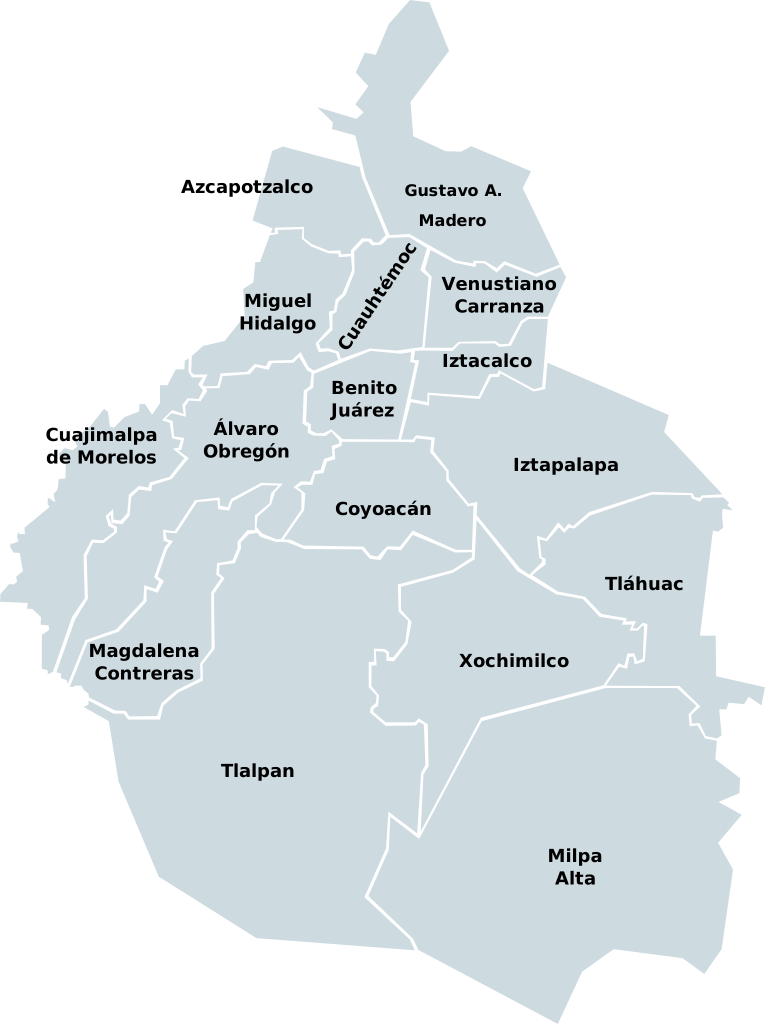
Authorities in Mexico City said "high-impact" crimes like murder or shootings had dropped by 20% overall this year in one sector, the mayoral district of Benito Juárez, thanks in part to better governance. The city's Security Cabinet said criminal killings (homicidios dolosos) had dropped by just over 31% this year in comparison with 2024, firearm injuries had halved and all forms of car theft had fallen by over 25%, El Sol de México reported on 21 Decembre. The district, a generally prosperous part of the city, is divided into five policing sectors (del Valle, Nárvarte-Álamos, Portales, Nativitas and Nápoles). Officials said no murders, house thefts or cash-point and taxi muggings had been reported in the preceding four months in the del Valle, Portales and Nápoles sectors. The mayor of Benito Juárez, Luis Mendoza, said this was the fruit of institutional coordination, working with residents and technology.
Saturday, 20 December 2025

Bogotá mayor's popularity slumps over "crime and transportation"

A poll from early December showed widespread dissatisfaction with the Bogotá mayor, Carlos Fernando Galán Pachón, in large part due to an increasing sense of insecurity. Galán had an approval rating of 26% as of 5 December, with 62% of Bogotá residents feeling unsafe, which was unprecedented since 2008 according to the poll Bogotá como vamos.  People were also dissatisfied with the Transmilenio bus network, a pioneering system that was nevertheless congested and providing fertile ground for petty crimes like theft and harassment, the public broadcaster reported. A particular source of concern was an apparent increase in brazen street violence, with the city counting 242 deadly brawls this year between 1 January and 30 September, RTVC reported on 18 November.

Friday, 31 October 2025

Official says crime "clearly falling" in Mexico City

Mexico City's top police official has said violent crimes had dropped 10%, and the most violent crimes 12%, "this year in comparison with the last one" and that "in general terms," violence had fallen "significantly" in Mexico's capital since 2019. Pablo Vásquez Camacho, the city's Civil Security secretary, told Heraldo Radio on 30 October that "high impact" crimes like murder or kidnapping had "fallen by around 60%" since 2019. This, he said, was thanks to better policing but also the implementation of social and economic programs in deprived parts of the city, El Heraldo de México reported. He repeated his statements that day attending a debate on crime in the city's legislative assembly. He spoke of measures taken under the mayoress Clara Brugada Molina to improve police equipment, pay and work conditions in a systematic bid to stamp out abuse and boost professionalization. Police, he said, had arrested more than 6,700 suspects for high-impact crimes with a 21% increase in prosecutions, and key arrests had allowed the dismantling of "30 criminal cells" over an unspecified period, the website Infobae reported.

Saturday, 13 June 2015

Bogotá police to confiscate sharp items on streets, to curb attacks

Authorities in Bogota will confiscate knives and sharp items found in public, and admonish and possibly fine people found with potentially harmful items, in response to a reported rise in armed attacks in Bogotá. The city issued a decree on 11 June instructing police to detain anyone found with such items for six hours and explain to them how these could be dangerous even if carried in self-defence, El Tiempo reported on 12 June. Detained persons would have to sign a pledge of good conduct up to two times, then face a fine if found a third time with such items, Radio Santa Fe reported. The Metropolitan Police chief Humberto Guatibonza was cited as saying that police were seeing more attacks with blunt instruments in the capital, attributed to the unrestricted sale of potentially dangerous artefacts and a clampdown on carrying firearms since 2012. That had effectively forced criminals to use blunt weapons in violent thefts, he said. Police declared they had confisctated 180,000 blunt weapons of various types so far this year, and would proceed to look for such items in parks and public transportation, El Tiempo reported. The city government separately reported on 12 June that it was carrying out security checks on the city's Transmilenio bus network, and had so far detained 10 people for thefts and 18 for jumping onto buses without paying.

Saturday, 8 March 2014

Homicides said at "alarming" levels in Venezuela

Venezuela's El Universal newspaper gave on 7 March the figure of 2,841 homicides across Venezuela for the first two months of 2014, citing unofficial and unspecified sources of the state criminal investigation agency CICPC. The daily observed this was 265 criminal killings more than the 2,576 reported for the same months in 2013. Venezuela and its capital have some of the world's highest crime rates, though the Government has increasingly restricted the revelation of crime statistics. The newspaper 2001 reported on 8 March that "at least" 92 bodies had been taken to the main Caracas morgue, Bello Monte, in the first seven days of March. The figure is taken as an indicator of the number of criminal or violent deaths occurring in the Caracas Metropolitan District.

Monday, 27 January 2014

Bogotá attains "lowest murder rate in 30 years"

Colombia's capital Bogotá was said to have "stabilised" its lowered murder rate in 2013, after a significant fall over 2012-13 attributed to factors including effective policing and restrictions on carrying arms and drinking. Coroners were cited as counting 1,279 murders in Bogotá in 2013, four less than in 2012, which translated into a rate of 16.7 murders per 100,000 inhabitants, El Tiempo reported on 27 January. The rate was far below those of the continent's most dangerous cities for 2013. The last of a recently published list of the 50 most murderous cities in the world in 2013 was Valencia in Venezuela, with a killing rate of 30 per 100,000 inhabitants. El Tiempo cited a security specialist Jairo Libreros as saying that it was difficult for Bogotá's murder rate to fall much more immediately, given the significant fall from a rate of 22.1 to 16.9/100,000 over 2012-13. Authorities reportedly attributed 39 per cent of killing deaths in 2013 to "vengence" and 35 per cent to brawls, while firearms were responsible for 61.5 per cent of killings.

Saturday, 18 January 2014

Over 200 killed in Caracas in fortnight

The principal morgue in Caracas was reported to have received 210 bodies in 2014 up to midday on 16 January, or roughly 12 a day and including seven policemen, Venezuela's El Universal reported, confirming the city's reputation as one of the world's deadliest. Caracas was recently cited as the world's second most dangerous city in 2013, with a murder rate of over 134 killings per 100,000 inhabitants. Insecurity has become a chief point of dispute between the socialist government of Nicolás Maduro and liberal opposition forces, and reportedly one of the reasons why many Venezuelans were emigrating. President Maduro urged political actors on 17 January to exclude security from politics, saying it was "criminal" to make "economic and political capital" out of people's grief, El Universal reported. He urged state governors and mayors to join the Government's efforts to curb crime but also to help change a pervasive media culture, which he said "adulated" drugs and violence. The opposition he alleged, had engaged in a policy of "throwing stones" at his government, but he also denounced the "death statistics" or polls that publicised crime rates in the country. The Mexican NGO Citizens Council for Public Security and Penal Justice recently reported 4,364 criminal killings in 2013 in Caracas, which has just under 3.248 million residents.

Thursday, 9 January 2014

Gang says helped reduce Medellín crime, murders increased in Cali in 2013

The Colombian city of Cali, one of the country's most violent, countered the downward trend in violent crime authorities reported for 2013, while gangs claimed in the city of Medellín that they rather than police had curbed violence there in 2013. In Medellín officials counted 920 murders for 2013, 331 less than in 2012, which reduced the murder rate per 100,000 inhabitants from 52 in 2012 to 38 in 2013, El Tiempo recently reported. The city witnessed 37 days with no murders that year, compared to 13 in 2012, El Colombiano reported on 9 January, citing a deputy-mayor Luis Fernández Vélez Suárez. The daily cited the head of a local NGO, Corporación para el Desarrollo y la Paz, as saying that one of Colombia's main criminal gangs, Los Urabeños, distributed pamphlets in parts of the city last November stating that "in spite of what officials say," the reduction was for the "efforts" made by several gangs to give residents some "peace and quiet." This was apparently a reference to a ceasefire in place since July 2013 between the Urabeños and the rival Oficina de Envigado, activists were cited as saying. Deputy-mayor Fernández said violent crime has steadily declined in Medellín since 1991, and fell sharply in 2012, regardless of any pact. Reported murders increased however in the south-western city of Cali, and officials have asked the local military to extend provisional restrictions on carrying arms, due to end on 31 January 2014. City Ombudsman Andrés Santamaria said the arms ban that began on 13 December was clearly effective as December murders had dropped from 236 in 2012 to 136, the Cali newspaper El País reported on 9 January. It observed that the local garrison, which emits arms permits, was reluctant to extend the ban, going against the trend in Bogotá and Medellín. There were 1962 reported killings in Cali in 2013 - 89 per cent being shooting deaths - 123 more than in 2012, El País reported.

Monday, 6 January 2014

President says crime dropped in Colombia over 2012-13

Colombia's President Juan Manuel Santos expressed satisfaction at the apparent reduction of violent crimes in Colombia over 2013, writing on his Twitter account on 5 January. Mr Santos said that homicides dropped eight percent, from 16,033 cases in 2012 to 14,782 in 2013, while reported kidnapping cases dropped four per cent in that time. His comments, reported on the Presidential website, were likely based on figures given by the Defence and Interior ministries and the armed forces. He observed that no kidnapping was reported in 2013 in 981 municipalities of Colombia or 89 per cent of its territory. Other positive figures given included the capture of 1,087 fighters of the two guerrilla armies, the FARC and the ELN, and the dismantling of 106 extortion gangs. The Defence Ministry reported on Twitter on 5 January that it caught 2,757 suspected criminals in 2013. Colombia's last, conservative president Álvaro Uribe Vélez questioned the claims - repeatedly urging Mr Santos not to "confuse" Colombians on his Twitter account - asserting that kidnappings increased 13 per cent over 2010-13, during the Santos presidency, Caracol television reported. He wrote that thefts against shops and businesses increased 47 per cent in that period, while there was a 223 per cent increase in attacks on oil and gas pipelines. Mr Uribe's statistical sources were not immediately clear on Twitter. Separately, troops shot on 2 January three suspected guerrillas of the Revolutionary Armed Forces of Colombia (FARC) in fighting in the southern department of Caquetá, and later destroyed a makeshift drug laboratory, El Espectador reported, citing Agence France-Presse. Locals were said to have tipped off the authorities of the presence of guerrillas, provisionally identified as from the FARC's Front 14, though reports did not specify where the fighting took place.

Saturday, 26 October 2013

Mexico counts over 100,000 killings in six-year drug war

A Mexican interior ministry agency reported that over 104,000 people were killed in criminal violence between 2006 and 2012 when Mexico's last president, Felipe Calderón Hinojosa, waged a relentless and controversial war on drug cartels and organised crime, papers reported on 25 October. The present government, led by Enrique Peña Nieto, seemed to face similar levels of violence in spite of boasting better intelligence and a more coordinated approach to fighting organised crime. The figure given by the SNSP (Sistema Nacional de Seguridad Pública) for reported or registered homicides during the Calderón presidency was 104,096 victims. Mexican authorities have repeated that most of these were were criminals and cartel operatives killed by each other or in shootouts with state forces. The report identified 2011 as the most mortiferous year with 22,856 homicides followed by 2010, with 20,681 homicides, the daily Milenio reported on 25 October. The newspaper cited figures showing a steady rise in homicides from 2007 to 2012. The SNSP counted 15,552 homicides in the first ten months of the Peña presidency, which began on 1 December 2012, Milenio reported on 25 October.

Thursday, 15 August 2013

Daily sees "slight" fall in murders in Bogotá for arms ban

The ban on carrying arms in Bogotá, imposed in recent months by the city government and the army, is said to have had an "insufficient" effect on reducing violent crimes, according to the newspaper ADN. The daily is freely distributed on the streets; it was citing figures from the police and state coroners. The daily's website reported on 14 August that there were 708 homicides in Bogotá from 1 January to the end of July 2013, five per cent less than the 743 homicides counted for that period in 2012; 453 of those killed in the period cited in 2013 were shot dead, evidently in spite of the existing arms ban. The ban is regularly renewed, and the capital's police chief Luis Martínez Guzmán said it was best it be maintained. Police confiscated 1,473 "illegal weapons" in the capital in the first seven months of 2013, ADN reported.

Tuesday, 30 July 2013

Residents hand in firearms in northern Bogotá, given tokens

Residents of the district of Usaquén north of Bogotá handed in on 29 July lethal objects including firearms and grenades in exchange for supermarket vouchers in another of the disarmament events that have become part of the measures taken by the city government to curb crime in Colombia's capital. Twenty three residents responded to the local municipality's calls to leave items that included in this case 25 hand grenades and 10 firearms; children handed in plastic guns and "martial toys" in exchange for T-shirts, caps, chocolate and board games, the office of the Bogotá Government Secretary coordinating security in the capital reported. Usaquén had a population of a little under 480,000 in 2012. Those who disarm this way are exempt from police investigation; in Usaquén they received shopping vouchers to spend in Éxito supermarkets on food and household items but not alcohol or tobacco. The mayoress of Usaquén Julieta Naranjo Luján termed this first disarmament event in Usaquén a success, telling a gathering it would "reduce homicides, crimes and personal injuries to much lower levels in the city." The Usaquén Police chief Colonel Pedro Ruiz Pulido was cited as saying that there were 33 homicides "so far this year" in Usaquén, of which 88 per cent were committed with firearms. Authorities attributed 91 per cent of homicides registered in Usaquén to "personal problems resulting from social intolerance" and acts of vengence "mostly" following excessive drinking, the office of the Bogotá Government Secretary reported.

Tuesday, 9 July 2013

Residents of Bogotá suburb hand in firearms, grenades

Municipal authorities of the district of Usme south of Bogotá were satisfied with the response to a disarmament day organized in that district, which yielded more than 20 firearms and weaponry thought directly related to violent crimes including the 31 homicides reported in Usme from 1 January to 31 May. The Bogotá municipality led by the Mayor Gustavo Petro has pursued disarmament as one of the means of reducing murders in and around the capital. The undated disarmament day brought in a range of items including "13 firearms," nine grenades, a "home-made grenade launcher" and "home-made shotgun," the Bogotá Government Secretary, the office that coordinates the capital's security affairs, reported on 9 July. Those who surrendered such items were exempted from investigations or prosecution for possession of arms, and given vouchers for the Éxito supermarket chain, a Deputy-Government Secretary of Bogotá Hugo Zarrate declared. He said disarmament "alongside other policies" had by 31 May reduced the homicide rate to 14.8 per 100,000 inhabitants, compared to 16.8 for 2012. It appeared he was speaking about all of Bogotá, though the report did not specify.